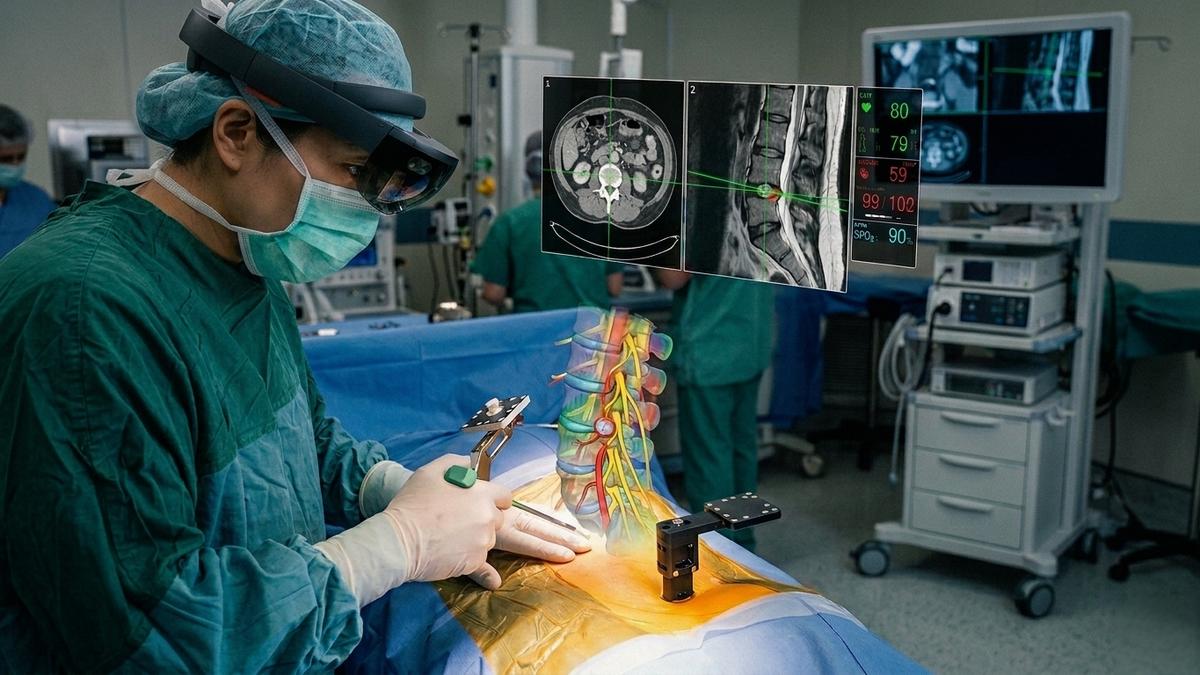
Imagine a surgical theater where the boundary between digital blueprint and physical anatomy dissolves. Where the surgeon's gaze, once tethered to wall-mounted screens, now projects three-dimensional holographic reconstructions directly onto the operative field. This is not speculative fiction—it is the emerging reality of augmented reality (AR) heads-up displays (HUDs) in spinal navigation, a technological leap that promises to redefine the very ergonomics of precision surgery.
The Cognitive Tax of Traditional Navigation
For decades, spinal fusion procedures have demanded a high cognitive load: surgeons must constantly shift their focus between the patient's exposed anatomy and two-dimensional screens displaying preoperative CT data. This visual translation—often described as the "cognitive tax" of modern surgery—introduces micro-delays and mental fatigue. Studies in human factors engineering suggest that each glance away from the surgical field requires approximately 1.5 seconds of reorientation (Liu et al., 2023). In a multi-level fusion, these accumulated seconds translate to extended operative times and increased cognitive strain.
AR HUDs: The Direct Line-of-Sight Paradigm
Augmented reality systems like the xvision Spine System (XVS) fundamentally alter this dynamic. By anchoring holographic trajectories directly to the patient's bone, they create what engineers call "persistent visual focus." The surgeon sees drill paths, screw trajectories, and neural boundaries overlaid in real time, eliminating the need for visual translation. Clinical validation data from Augmedics' registry shows screw placement accuracy rates of 98–99% in peer-reviewed cohorts, matching or exceeding traditional infrared navigation systems.
The technical architecture enabling this shift involves three core components:
- Optical Tracking Arrays: Small, wireless markers create a dynamic coordinate system that updates in real time as the patient or instruments move.
- Holographic Rendering Engines: These process preoperative DICOM data into three-dimensional meshes that appear semi-transparent, creating the illusion of "virtual transparency" through bone.
- Ergonomic Headset Design: Modern AR headsets weigh under 500 grams, maintain full peripheral vision, and operate wirelessly for up to four hours—sufficient for most complex spinal procedures.
The Global Adoption Landscape
In the United States and Europe, AR navigation has progressed from early feasibility studies to growing clinical adoption. The FDA's 510(k) clearance of the XVS system in 2021 marked a regulatory milestone, followed by CE marking for European markets. In China, the National Medical Products Administration (NMPA) has approved several domestic AR and optical navigation systems, supporting deployment in high-volume trauma centers (specific approval records: NMPA 2023-医疗器械-AR导航类).
What distinguishes AR from robotic platforms is its capital efficiency. While robotic spine installations can exceed USD 1.5 million in hardware costs alone, AR systems offer comparable navigational accuracy at approximately one-third the capital expenditure. For Southeast Asian healthcare networks in Thailand, Malaysia, and Indonesia, this represents a viable pathway to surgical precision without prohibitive financial barriers.
The Horizon: Predictive Analytics and Biomechanical Simulation
The next evolutionary phase integrates predictive software directly into the AR interface. During spinal deformity corrections, for example, the headset will not only show screw trajectories but will simulate the mechanical stress distribution across adjacent segments as the spine is straightened. Early research from Stanford's Bioengineering Department demonstrates prototype systems that calculate load-sharing ratios in real time, alerting surgeons to potential stress concentrations before they manifest clinically.
This convergence of navigation and simulation represents a fundamental shift: the operating room transitions from a space of physical execution to an environment of real-time, data-enhanced decision-making. As processor speeds increase and machine learning algorithms mature, we may see AR systems that recommend optimal implant sizing based on patient-specific biomechanics or predict fusion success probabilities based on bone density patterns.
Implications for Surgical Training and Global Equity
Perhaps the most profound impact of AR navigation lies in surgical education. Trainees wearing AR headsets can see expert surgeons' annotations and decision points overlaid on their own visual field, creating what educational researchers call "cognitive apprenticeship at scale." This has particular relevance for Southeast Asia, where AR systems could facilitate remote proctoring and skill transfer without requiring physical presence of international experts.
As AR hardware costs continue to decline—following the typical technology adoption curve—we anticipate that by 2030, AR-assisted navigation will become the standard of care for complex spinal procedures in most major medical centers worldwide. The question for healthcare systems is not whether to adopt this technology, but how rapidly to integrate it into their surgical workflows to maintain competitive clinical outcomes.
Disclaimer: This article provides general industry information and does not constitute regulatory or legal advice. For specific compliance requirements, please consult with our procurement advisory team or relevant national authorities.
Clinical references: Liu et al. (2023) Augmented Reality in Spine Surgery: Accuracy and Learning Curve; Augmedics xvision Spine System Clinical Registry Data; NMPA Approval Records 2023-医疗器械-AR导航类.